China: A Country of Contrasts, History, and Tradition
A Taste of Culture


China is one of the largest and oldest countries in the world.
Its population represents nearly 17% of the global population, making it one of the most populated countries on Earth. It is also the second largest country in Asia, home to landscapes that range from mountains and deserts to rice fields, forests, modern cities, and traditional villages.
But China’s diversity is not only visible in its landscapes. It is also reflected in its culture, traditions, and cuisine.
China cannot be understood as a single uniform culinary tradition. Each region has its own history, climate, ingredients, dialects, and ways of cooking. That is why speaking about “Chinese food” in general often falls short.
Northern cuisine, for example, is deeply shaped by wheat, doughs, and noodles, while southern cuisine is more closely connected to rice and lighter preparations.
The Eight Great Cuisines of China


In a country as large as China, geography, climate, and history shaped very different ways of cooking.
Some regions are known for intense spicy flavors, others for delicate techniques, seafood, steamed dishes, or wheat-based doughs. One of the most recognized ways to understand this diversity is through the Eight Great Cuisines of China, eight culinary traditions that reflect how one country can have completely different approaches to flavor and cooking.
- Shandong / Lu → salty and fresh flavors, seafood, and wheat-based dishes from northern coastal China
- Sichuan / Chuan → bold spicy flavors and the famous numbing Sichuan peppercorn
- Cantonese / Yue → lighter flavors, delicate techniques, and dim sum (small dishes traditionally shared at the table) traditions from southern China
- Fujian / Min → soups, seafood, umami (a deep savory flavor), and complex cooking techniques
- Jiangsu / Su → refined cuisine with attention to texture and presentation
- Zhejiang / Zhe → fresh and delicate dishes with river and coastal ingredients
- Hunan / Xiang → intense spice, smoked flavors, and fermented ingredients
- Anhui / Hui → wild herbs, mountain ingredients, and slow cooking techniques
This diversity also reminds us that Chinese cuisine cannot be defined by a single ingredient or technique.
While rice dominates many southern regions, wheat became the foundation of northern Chinese cooking.
Wheat: The Foundation of Northern Chinese Cooking


If rice is often associated with southern China, wheat tells the story of the north.
In many northern regions, the colder and drier climate made wheat one of the most important staple crops, shaping a culinary tradition based on flour, dough, and handmade textures.
This tradition reveals a more hands-on side of Chinese cuisine. Flour is mixed with water, kneaded, rested, rolled, stretched, and folded, transforming simple ingredients into foods that feel deeply comforting and familiar.
In northern kitchens, dough itself becomes part of the experience: something made with patience, skill, and often shared around the table.
Among these wheat-based foods, dumplings hold a special place.
Dumplings: Small Parcels Full of Meaning


Small in size, but full of meaning.
Inside every filling, fold, and cooking method lives a tradition passed down through generations.
Dumplings, especially jiaozi, are among the most beloved dishes in Chinese cuisine. Made with thin wheat dough and filled with meat, vegetables, eggs, seafood, or other ingredients, they can be boiled, steamed, or pan-fried.
But beyond their shape or preparation, their importance lies in what they represent: togetherness, care, and tradition.
In northern China, dumplings are especially important during Lunar New Year. Their shape is often associated with ancient gold and silver ingots, making them symbols of prosperity and good fortune.
Yet dumplings also carry something even more important: family. They are often prepared together, with people gathering around the table to fill, fold, and share them.
That is part of what makes dumplings so special. They are not only about the final dish, but also about the process itself: the dough, the filling, the folding, and even the small imperfections that make every piece unique.
Some dumplings may look more elegant, others more homemade, but each one carries the hands of the person who made it.
Today’s Dish: Dumplings
For this journey, we prepared two homemade versions: one vegetarian and one with meat.
Two simple variations that reflect what makes Chinese cooking so special: sharing, adapting, and cooking with intention.
Recipe Overview
Dish: Dumplings (Jiaozi)
Cuisine: Chinese
Difficulty: Medium
Prep time: 220 minutes
Cooking time: 60 minutes
Servings: 10

Ingredients
Vegetarian Filling
- 10 eggs
- 1.5 kg carrots
- 3 leeks
- 2 zucchinis
- Ginger
- 200 g glass noodles
- 5 tbsp oyster sauce
- 10 tbsp soy sauce
- 10 tbsp sesame oil
- Salt
- Pepper
- Sesame seeds
Dough
- 1 liter water
- 2 kg flour
- 2 pinches salt
- 2 tsp canola oil
Meat Filling
- 2 eggs
- 1.5 kg carrots
- 2 leeks
- 1 kg ground beef
- 15 tbsp oyster sauce
- 21 tbsp soy sauce
- 15 tbsp sesame oil
- Chinese five spice
- Salt
- Pepper
Sauce (Optional)
- 1 tsp Lao Gan Ma chili crisp
- 6 tbsp soy sauce
- 6 tbsp rice vinegar
- 1 tbsp sesame oil
- 1 tsp sugar


Preparation
Step 1. Prepare the Dough
- In a large bowl or stand mixer, combine the flour, salt, oil, and water gradually.
- Once combined, knead the dough by hand until smooth and elastic.
- Form a long cylinder and cut it into small equal pieces.
- Flatten each piece slightly with your palm.
- Using a rolling pin, roll each piece evenly into thin circular wrappers.


Step 2. Prepare the Vegetarian Filling
- Grate the carrots and ginger, finely chop the leeks, and mix them with 3 tbsp oyster sauce, 6 tbsp soy sauce, 6 tbsp sesame oil, salt, and pepper.
- Soak the glass noodles in hot water for about 4 minutes, then rinse with cold water and cut into small pieces.
- Season the noodles with 4 tbsp soy sauce, 4 tbsp sesame oil, 2 tbsp oyster sauce, and salt.
- In a pan, scramble the eggs with finely chopped leek.
- Combine the vegetables, eggs, and noodles together.
- Finally, grate the zucchini and mix it in right before filling the dumplings to avoid excess water.


Step 3. Prepare the Meat Filling
- In a bowl, combine the beef, grated carrots, ginger, and finely chopped leeks.
- Add the eggs, soy sauce, oyster sauce, sesame oil, Chinese five spice, salt, and pepper.
- Mix until fully combined.

Step 4. Fill and Fold the Dumplings
- Place filling in the center of the wrapper, making sure not to overfill.
- Fold and seal the dumplings using your preferred shape.
Shape 1
- Bring both outer sides toward the center, creating a shape similar to a small taco.
- Then take the top edge and fold it toward the center, closing the opening between the center and top section.
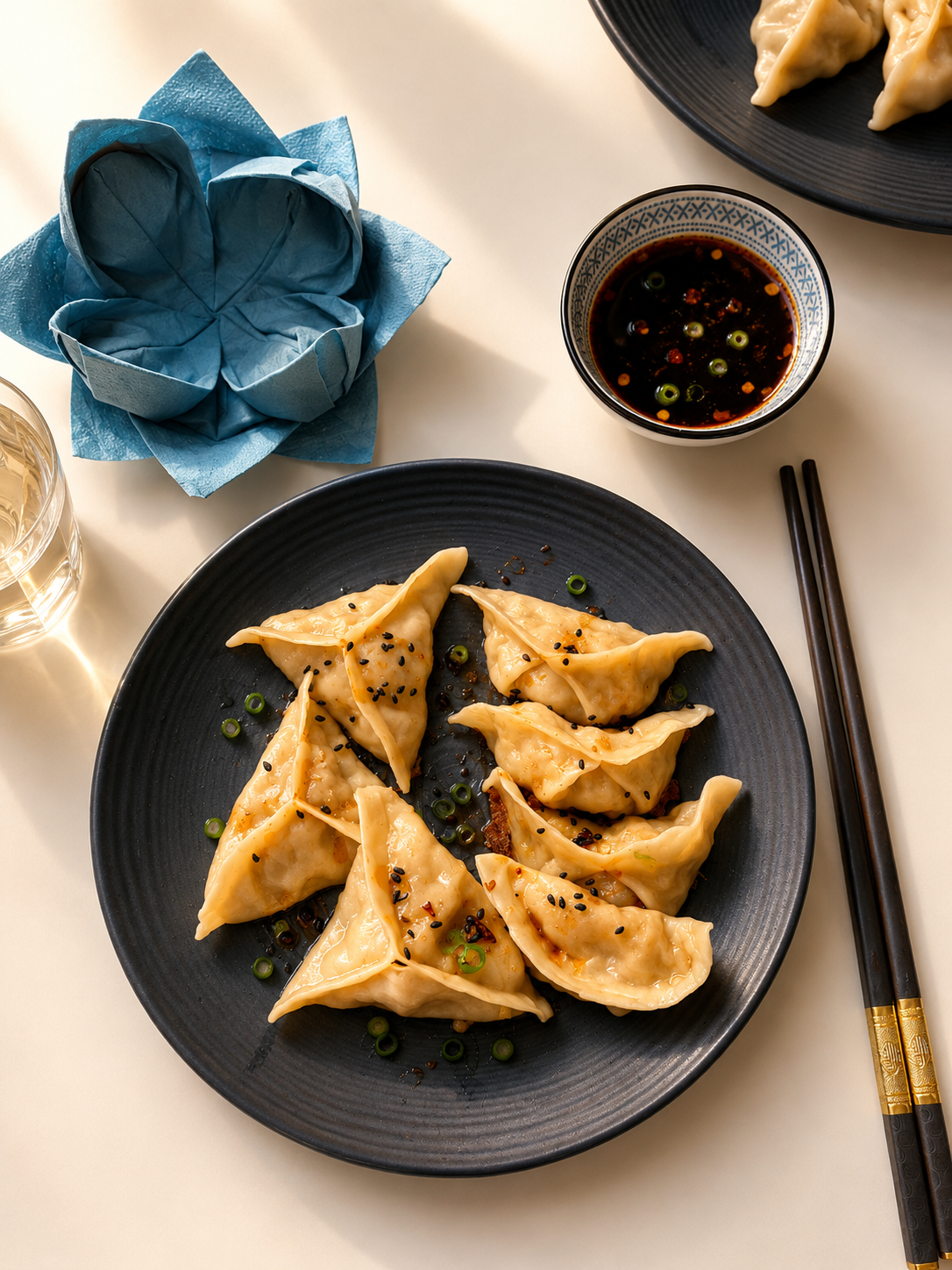
- Fold one corner inward and press gently to seal it. Repeat the same process on the opposite side until the dumpling is fully closed. (See photo reference.)
Shape 2
- Bring both outer sides toward the center, sealing only the top section first.
- Repeat this process on each side until all three sections are closed. (See photo reference.)
- Repeat with the remaining dumplings.
- Each fold may look slightly different, and that is part of what makes handmade dumplings unique.


Step 5. Cook the Dumplings
- Steam the dumplings at 100°C for 12–15 minutes if using a steamer.
- Alternatively, cook them in a pan with oil and a small amount of water.
- Cover the pan until the water evaporates and the dough is fully cooked.


Step 6. Prepare the Sauce
- In a small bowl, mix the soy sauce, rice vinegar, sesame oil, sugar, and Lao Gan Ma chili crisp until well combined.

Serve the dumplings warm with the sauce on the side and with a sprinkle of sesame seed. Enjoy!
Want to see each step in action? Follow us on Instagram and TikTok for the full cooking process.
Where to Find the Ingredients?
All ingredients used in this recipe can be found in Asian supermarkets across Switzerland.
Sources
Regional Eating Habits in China
Chinese Cuisine from Ancient Times to the Present
Continue the journey
From China, our journey continues…
Leave a Reply